C. Oregon Housing Market Update: October 2026. Bend vs. the Rest of Deschutes County
For the latter half of this year, if you had asked me whether Deschutes County was having a good year, I probably would have said yes.
Now, I’m not so sure.
How Deschutes County looks in 2026
Although it might not feel like it, the county-level numbers show an improving market compared to the last two years. Compared to 2025, the number of homes sold this year is up 6.4%. Total sales volume is up 7.6%, even while the median sale price is down 0.8%. In other words, more homes are selling and more money is changing hands, despite the median price being slightly lower.
The problem is that those numbers haven't reflected what I've been seeing and hearing in my day-to-day business. That disconnect has left me a little confused, and at times at a loss for words when someone asks the most basic question: How's the market?
Over the last month, I changed the way I pull and analyze the data, and suddenly that disconnect made a lot more sense.
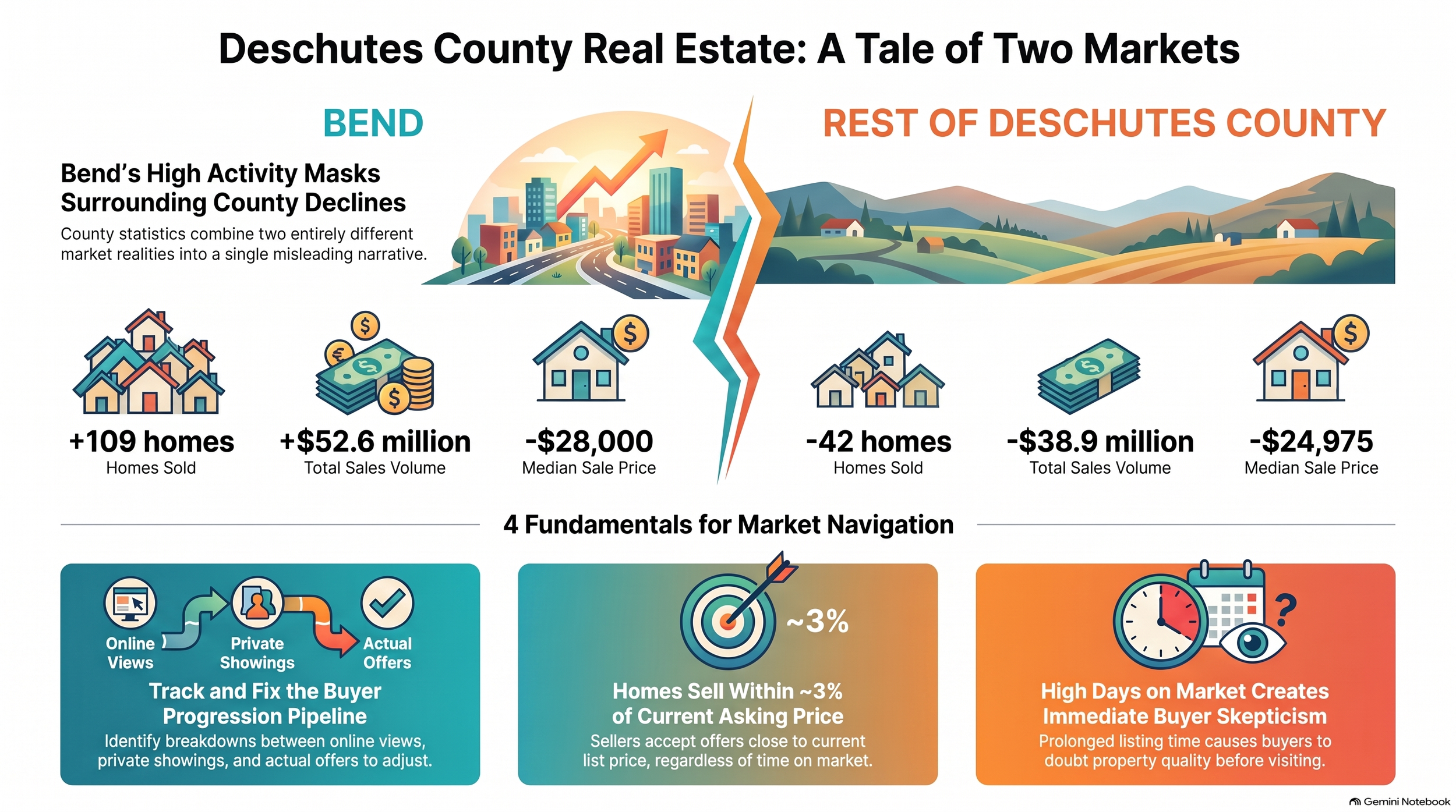
It’s no secret that Bend carries a significant amount of weight in Deschutes County's overall housing statistics. We also know Bend has seen improved sales activity this year. What surprised me was just how much Bend has been masking what's happening throughout the rest of the county.
Bend vs. the rest of Deschutes County (Jan–Sep 2026 vs. 2025)
| Bend | Rest of Deschutes County | |
|---|---|---|
| Homes sold | +109 | -42 |
| Sales volume | +$52.6M | -$38.9M |
| Median price | -$28,000 | -$24,975 |
Bend is seeing more transactions despite softer prices. Outside Bend, both transaction activity and prices have declined.
Those are two very different stories being combined into one county-level statistic.
Even with this added clarity, it doesn't necessarily make buying or selling a home any easier. But it certainly doesn't make it impossible. The market may change from city to city, price point to price point, and even neighborhood to neighborhood, but the best practices for navigating it don't change nearly as much. In a market this nuanced, they become even more important.
Four fundamentals for buyers and sellers right now:
Attention needs to turn into interest, and interest needs to turn into offers. Online views should lead to private showings, and private showings should eventually lead to offers. If that progression stops somewhere along the way, identify where it's breaking down and make the appropriate adjustment.
If you want the home, understand where sellers are actually saying yes. On average, homes are selling within about 3% of their current asking price, regardless of how long they've been on the market.
You can't underprice a home in any market, even this one. If a home is priced well for what it offers, buyers notice. When enough buyers notice at the same time, multiple offers can still happen.
Days on market is a killer in any market, but especially this one. Before buyers ever physically walk through a home, a high number of days on market can turn even a great property into a question mark. Buyers start wondering what everyone else saw that they haven't.
The clearer I've gotten on what is actually happening within each part of the market, the more I've come back to the same conclusion: when the market gets murky, the fundamentals become your North Star.
If you want to see how each market performed in September, download the free H.O.M.E. Report or contact me. You can also see Bend market trends and Redmond market trends